Linear Regression
-
Describe the null hypotheses to which the p-values given in Table 3.4 correspond. Explain what conclusions you can draw based on these $p$-values. Your explanation should be phrased in terms of
sales,TV,radio, andnewspaper, rather than in terms of the coefficients of the linear model.Hipotezy zerowe dla tabeli 3.4:
$(TV) H_0: \beta_1 = 0$
$(Radio) H_0: \beta_2 = 0$
$(Newspaper) H_0: \beta_3 = 0$
$p$-values dla TV i Radio są małe, co oznacza, że hipotezy zerowe muszą być odrzucone. Pokazuje to, że zmienna objaśniana silnie zależy od wspomnianych dwóch zmiennych objaśniających. $p$-value dla Newspaper jest duże co oznacza, że $\beta_2=0$ czyli ta zmienna nie ma wpływu na zmienną objaśnianą.
-
Carefully explain the differences between the KNN classifier and KNN regression methods.
KNN odnosi się do nieparametrycznych metod, które mogą zostać użyte do klasyfikacji lub regresji.
Klasyfikator KNN określa $K$ najbliższych punktów wokół obserwacji $x_0$ w celach klasyfikacji. Następnie estymuje prawdopodobieństwo tego, że $x_0$ należy do danej klasy na podstawie sąsiednich obserwacji. Klasyfikator KNN daje odpowiedź jakościową.
Regresja KNN działa podobnie do klasyfikatora KNN jednak wyznaczana jest w tym przypadku ilościowa predykcja zależności $f(x_0)$.
-
Suppose we have a data set with five predictors, $X_1 = \text{GPA}$, $X_2 = \text{IQ}$, $X_3 = \text{Level}$ (1 for College and 0 for High School), $X_4 = $ Interaction between $\text{GPA}$ and $\text{IQ}$, and $X_5 =$ Interaction between $\text{GPA}$ and $\text{Level}$. The response is starting salary after graduation (in thousands of dollars). Suppose we use least squares to fit the model, and get $\hat{β}_0 = 50$, $\hat{β}_1 = 20$, $\hat{β}_2 = 0.07$, $\hat{β}_3 = 35$, $\hat{β}_4 = 0.01$, $\hat{β}_5 =−10$.
(a) Which answer is correct, and why?
Model z zadania wygląda następująco:
$Y = 50 + 20\cdot\text{GPA} + 0.07\cdot\text{IQ} + 35\cdot\text{Level} + 0.01\cdot\text{GPA}\cdot\text{IQ} - 10\cdot\text{GPA}\cdot\text{Level}$
i. For a fixed value of $\text{IQ}$ and $\text{GPA}$, high school graduates earn more, on average, than college graduates.
Fałsz, gdy $\text{Level} = 0$ to zarobki w modelu będą niższe.
ii. For a fixed value of $\text{IQ}$ and $\text{GPA}$, college graduates earn more, on average, than high school graduates.
Fałsz, w modelu jest czynnik $- 10\cdot\text{GPA}\cdot\text{Level}$ i dla odpowiednio wysokiego $\text{GPA}$ high school zarabia więcej od college.
iii. For a fixed value of $\text{IQ}$ and $\text{GPA}$, high school graduates earn more, on average, than college graduates provided that the $\text{GPA}$ is high enough.
Prawda.
iv. For a fixed value of $\text{IQ}$ and $\text{GPA}$, college graduates earn more, on average, than high school graduates provided that the GPA is high enough.
Fałsz.
(b) Predict the salary of a college graduate with $\text{IQ}$ of 110 and a $\text{GPA}$ of 4.0.
137.1
(c) True or false: Since the coefficient for the $\text{GPA/IQ}$ interaction term is very small, there is very little evidence of an interaction effect. Justify your answer.
Fałsz, niski współczynnik nie oznacza braku dowodu na interakcję. Ostatecznie trzeba określić $p$-value i wtedy zdecydować.
-
I collect a set of data ($n = 100$ observations) containing a single predictor and a quantitative response. I then fit a linear regression model to the data, as well as a separate cubic regression, i.e. $Y = \beta_0 + \beta_1X + \beta_2X^2 + \beta_3X^3 + \epsilon$.
(a) Suppose that the true relationship between $X$ and $Y$ is linear, i.e. $Y = \beta_0 + \beta_1X + \epsilon$. Consider the training residual sum of squares (RSS) for the linear regression, and also the training RSS for the cubic regression. Would we expect one to be lower than the other, would we expect them to be the same, or is there not enough information to tell? Justify your answer.
Dodanie kolejnego czynnika wielomianowego spowoduje bliższe dopasowanie do danych treningowych przez co RSS będzie mniejszy niż w przypadku prostej regresji liniowej.
(b) Answer (a) using test rather than training RSS.
Prawdziwa zależność jest liniowa więc statystyka F powinna wynosić więcej niż 1. W przypadku modelu wielomianowego powinniśmy spodziewać się wartości bliskiej 1 co oznacza, że jeden z współczynników wynosi 0.
(c) Suppose that the true relationship between $X$ and $Y$ is not linear, but we don’t know how far it is from linear. Consider the training RSS for the linear regression, and also the training RSS for the cubic regression. Would we expect one to be lower than the other, would we expect them to be the same, or is there not enough information to tell? Justify your answer.
Dodanie kolejnego czynnika wielomianowego spowoduje bliższe dopasowanie do danych treningowych przez co RSS będzie mniejszy niż w przypadku prostej regresji liniowej.
(d) Answer (c) using test rather than training RSS.
Prawdopodobnie uzyskamy wartości statystyki F powyżej 1 co oznacza, że jeden z współczynników nie wynosi 0.
-
Consider the fitted values that result from performing linear regression without an intercept. In this setting, the $i$-th fitted value takes the form
\[\hat{y}_i=x_i\hat{\beta},\]where
\[\hat{\beta}=\left(\sum\limits_{i=1}^n x_i y_i \right) / \left(\sum\limits_{i'=1}^n x_{i'}^2\right).\]Show that we can write
\[\hat{y}_i = \sum\limits_{i'=1}^n a_{i'}y_{i'}\]What is $a_{i’}$?
Note: We interpret this result by saying that the fitted values from linear regression are linear combinations of the response values.
\[\hat{y}_i = x_i\hat{\beta} = x_i \frac{\sum\limits_{i'=1}^n x_{i'} y_{i'}}{\sum\limits_{j=1}^n x_{j}^2} = \sum\limits_{i'=1}^n\frac{x_{i'} x_i}{\sum\limits_{j=1}^n x_{j}^2}y_{i'} = \sum\limits_{i'=1}^n a_{i'}y_{i'}\] \[a_{i'} = \frac{x_{i'} x_i}{\sum\limits_{j=1}^n x_{j}^2}\] -
Using (3.4), argue that in the case of simple linear regression, the least squares line always passes through the point $(\bar{x},\bar{y})$.
\[\hat{\beta}_1 = \frac{\sum_{i=1}^n(x_i-\bar{x})(y_i-\bar{y})}{\sum_{i=1}^n(x_i-\bar{x})^2}\] \[\hat{\beta}_0 = \bar{y} - \hat{\beta}_1\bar{x}\] \[\hat{y}_j = \hat{\beta}_0 + \hat{\beta}_1x_j\]gdy $x_j = \bar{x}$, to:
\[\hat{y}_j = \bar{y} - \hat{\beta}_1\bar{x} + \hat{\beta}_1\bar{x} = \bar{y}\]Jeżeli $x_j = \bar{x}$ to linia regresji przechodzi przez punkt $(\bar{x}, \bar{y})$.
-
It is claimed in the text that in the case of simple linear regression of $Y$ onto $X$, the $R^2$ statistic (3.17) is equal to the square of the correlation between $X$ and $Y$ (3.18). Prove that this is the case. For simplicity, you may assume that $\bar{x} = \bar{y} = 0$.
\[R^2 = \frac{TSS-RSS}{TSS}\] \[RSS = \sum_{i=1}^n(y_i-\hat{y}_i)^2\] \[TSS = \sum_{i=1}^ny_i^2\] \[\hat{y}_i = \hat{\beta}_1x_i\] \[\hat{\beta}_1 = \frac{\sum_{i=1}^nx_iy_i}{\sum_{i=1}^nx_i^2}\] \[\begin{aligned}R^2 &= \frac{TSS-RSS}{TSS} = \frac{\sum_{i=1}^ny_i^2 - \sum_{i=1}^n(y_i-\hat{y}_i)^2}{\sum_{i=1}^ny_i^2} = \\ &= \frac{\sum_{i=1}^ny_i^2 - \sum_{i=1}^n(y_i^2 - 2y_i\hat{y}_i +\hat{y}_i^2)}{\sum_{i=1}^ny_i^2} = \\ &= \frac{2\sum_{i=1}^ny_i\hat{y}_i - \sum_{i=1}^n\hat{y}_i^2}{\sum_{i=1}^ny_i^2} = \\ &= \frac{2\sum_{i=1}^ny_i\hat{\beta}_1x_i - \sum_{i=1}^n\hat{\beta}_1^2x_i^2}{\sum_{i=1}^ny_i^2} = \\ &= \frac{2\sum_{i=1}^ny_ix_i\frac{\sum_{i=1}^nx_iy_i}{\sum_{i=1}^nx_i^2} - \sum_{i=1}^nx_i^2 \left(\frac{\sum_{i=1}^nx_iy_i}{\sum_{i=1}^nx_i^2}\right)^2}{\sum_{i=1}^ny_i^2} = \\ &= \frac{2\frac{\left(\sum_{i=1}^nx_iy_i\right)^2}{\sum_{i=1}^nx_i^2} - \frac{\left(\sum_{i=1}^nx_iy_i\right)^2}{\sum_{i=1}^nx_i^2}}{\sum_{i=1}^ny_i^2} = \\ &= \frac{\frac{\left(\sum_{i=1}^nx_iy_i\right)^2}{\sum_{i=1}^nx_i^2}}{\sum_{i=1}^ny_i^2} = \\ &= \frac{\left(\sum_{i=1}^nx_iy_i\right)^2}{\sum_{i=1}^nx_i^2\sum_{i=1}^ny_i^2} = \\ &= Cor^2(X,Y)\end{aligned}\] -
This question involves the use of simple linear regression on the
Autodata set.(a) Use the
lm()function to perform a simple linear regression withmpgas the response andhorsepoweras the predictor. Use thesummary()function to print the results. Comment on the output.library(ISLR) data(Auto) mpg_pwr = lm(mpg ~ horsepower, data = Auto) summary(mpg_pwr)Call: lm(formula = mpg ~ horsepower, data = Auto) Residuals: Min 1Q Median 3Q Max -13.5710 -3.2592 -0.3435 2.7630 16.9240 Coefficients: Estimate Std. Error t value Pr(>|t|) (Intercept) 39.935861 0.717499 55.66 <2e-16 *** horsepower -0.157845 0.006446 -24.49 <2e-16 *** --- Signif. codes: 0 ‘***’ 0.001 ‘**’ 0.01 ‘*’ 0.05 ‘.’ 0.1 ‘ ’ 1 Residual standard error: 4.906 on 390 degrees of freedom Multiple R-squared: 0.6059, Adjusted R-squared: 0.6049 F-statistic: 599.7 on 1 and 390 DF, p-value: < 2.2e-16For example:
i. Is there a relationship between the predictor and the response?
Na podstawie $p$-value bliskiego zeru można stwierdzić, że istnieje zależność.
ii. How strong is the relationship between the predictor and the response?
Statystyka $R^2$ wynosi 0.61 co oznacza, że 61% wariancji zmiennej
mpgjest objaśniane przez model zhorsepower, oznacza to, że ponad połowa zmienności jest objaśniana przez model.iii. Is the relationship between the predictor and the response positive or negative?
Zależność jest negatywna. Na każdy 1 koń mechaniczny,
mpgspada o 0.158.iv. What is the predicted
mpgassociated with ahorsepowerof 98? What are the associated 95 % confidence and prediction intervals?predict(mpg_pwr, data.frame(horsepower=c(98)), interval='prediction')fit lwr upr 1 24.46708 14.8094 34.12476predict(mpg_pwr, data.frame(horsepower=c(98)), interval='confidence')fit lwr upr 1 24.46708 23.97308 24.96108(b) Plot the response and the predictor. Use the
abline()function to display the least squares regression line.plot(mpg~horsepower,main= "Scatter plot of mpg vs. horsepower", data=Auto) abline(mpg_pwr, lwd =3, col ="red")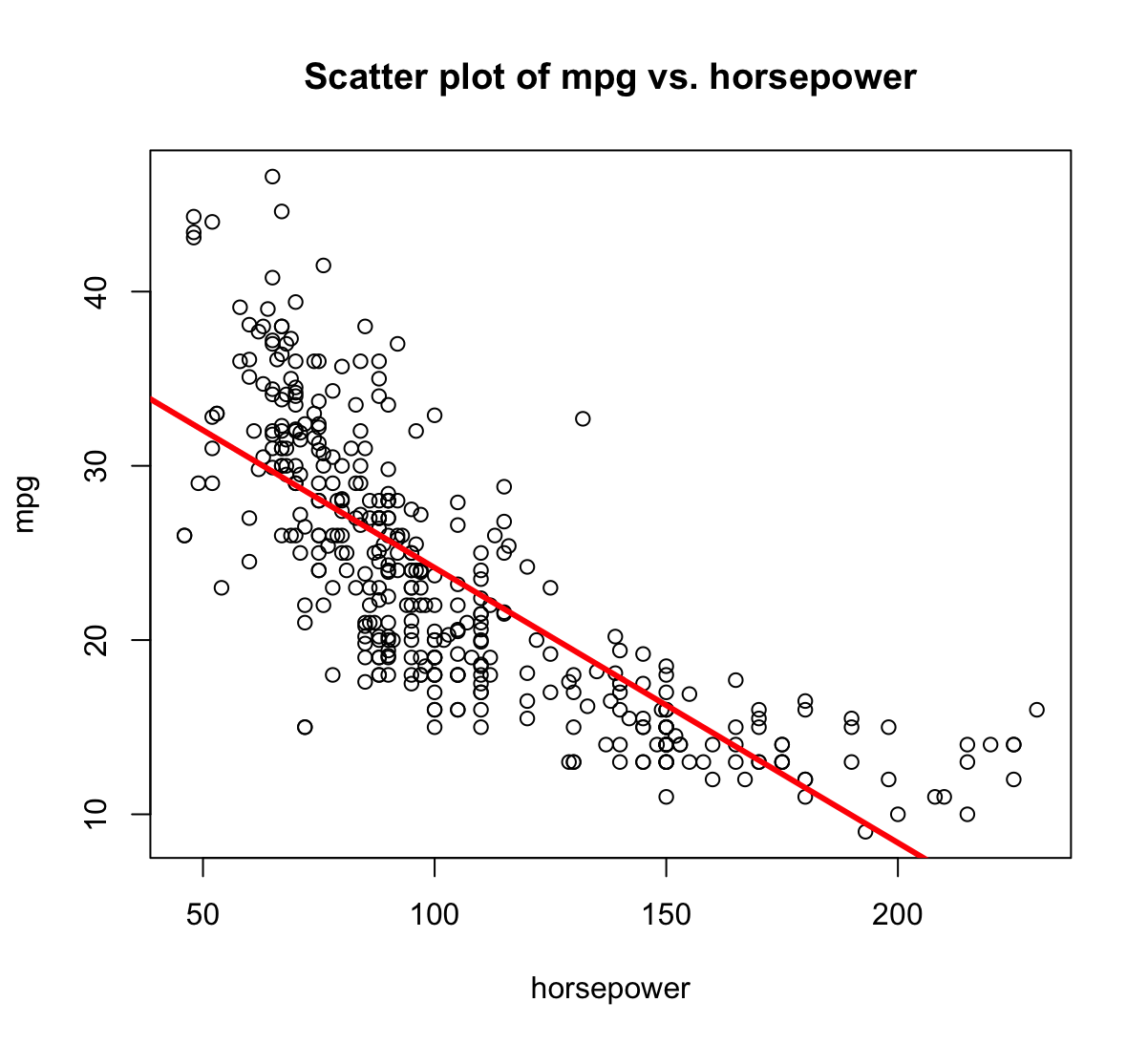
(c) Use the
plot()function to produce diagnostic plots of the least squares regression fit. Comment on any problems you see with the fit.par(mfrow=c(2,2)) plot(mpg_pwr)
- Residuals vs Fitted - widać pewną zależność w kształcie litery U co mówi o tym, że dane nie są liniowe.
- Residuals v leverage - wskazuje na pewne obserwacje z dużym wpływem na model.
- Scale-Location - wskazuje, że mogą występować pewne obserwacje odstające. Można je znaleźć używając komendy:
rstudent(mpg_pwr)[which(rstudent(mpg_pwr)>3)]323 330 3.508709 3.149671 -
This question involves the use of multiple linear regression on the
Autodata set.(a) Produce a scatterplot matrix which includes all of the variables in the data set.
 library(ISLR)
 data(Auto)
 Auto <- Auto[,1:8] # usuwam kolumnę name z danych
 pairs(Auto)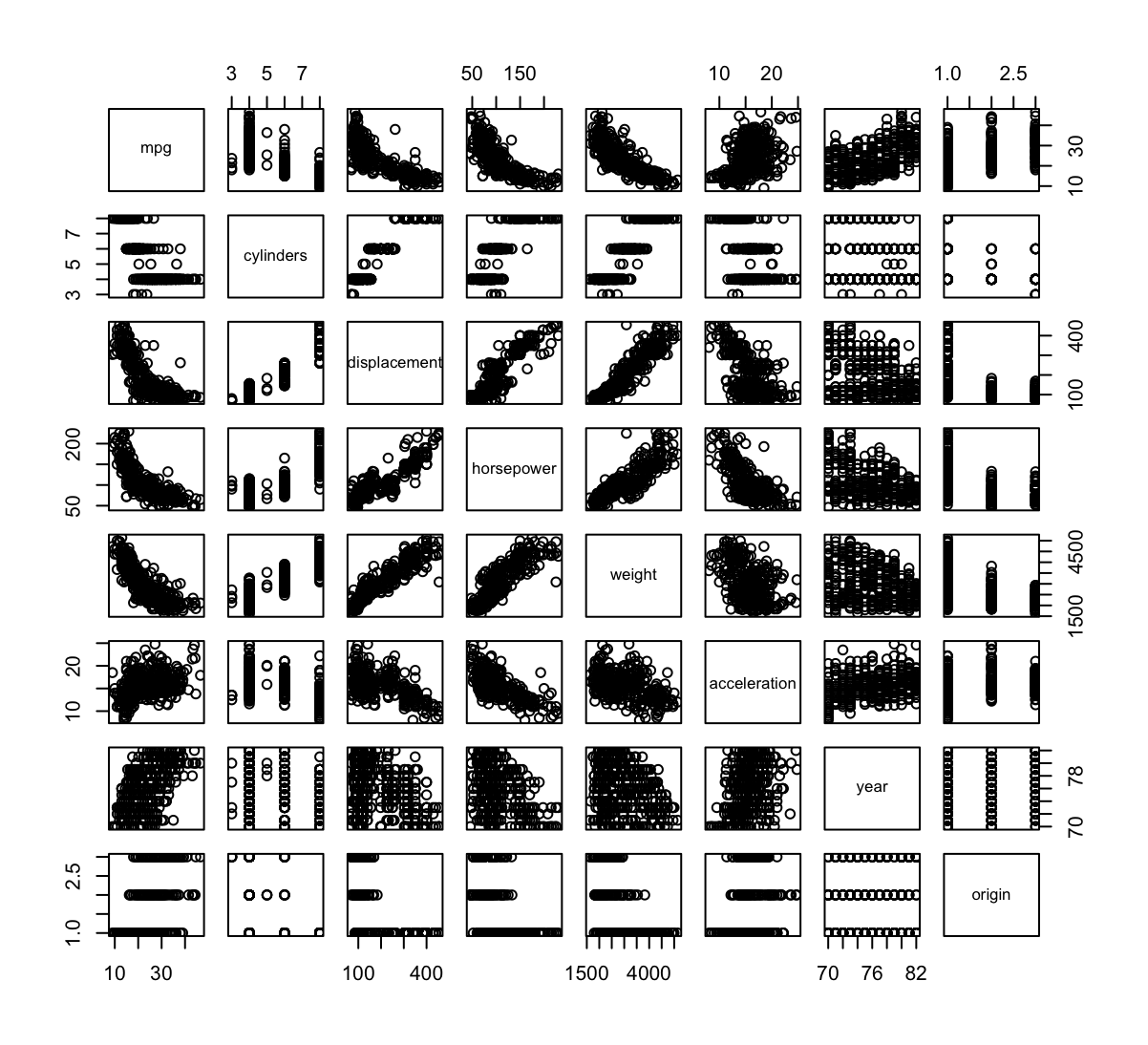
(b) Compute the matrix of correlations between the variables using the function
cor(). You will need to exclude thenamevariable, which is qualitative.cor(Auto)mpg cylinders displacement horsepower weight acceleration mpg 1.0000000 -0.7776175 -0.8051269 -0.7784268 -0.8322442 0.4233285 cylinders -0.7776175 1.0000000 0.9508233 0.8429834 0.8975273 -0.5046834 displacement -0.8051269 0.9508233 1.0000000 0.8972570 0.9329944 -0.5438005 horsepower -0.7784268 0.8429834 0.8972570 1.0000000 0.8645377 -0.6891955 weight -0.8322442 0.8975273 0.9329944 0.8645377 1.0000000 -0.4168392 acceleration 0.4233285 -0.5046834 -0.5438005 -0.6891955 -0.4168392 1.0000000 year 0.5805410 -0.3456474 -0.3698552 -0.4163615 -0.3091199 0.2903161 origin 0.5652088 -0.5689316 -0.6145351 -0.4551715 -0.5850054 0.2127458 year origin mpg 0.5805410 0.5652088 cylinders -0.3456474 -0.5689316 displacement -0.3698552 -0.6145351 horsepower -0.4163615 -0.4551715 weight -0.3091199 -0.5850054 acceleration 0.2903161 0.2127458 year 1.0000000 0.1815277 origin 0.1815277 1.0000000(c) Use the
lm()function to perform a multiple linear regression withmpgas the response and all other variables exceptnameas the predictors. Use thesummary()function to print the results. Comment on the output.mpg_all = lm(mpg ~ .,data=Auto) summary(mpg_all)Call: lm(formula = mpg ~ ., data = Auto) Residuals: Min 1Q Median 3Q Max -9.5903 -2.1565 -0.1169 1.8690 13.0604 Coefficients: Estimate Std. Error t value Pr(>|t|) (Intercept) -17.218435 4.644294 -3.707 0.00024 *** cylinders -0.493376 0.323282 -1.526 0.12780 displacement 0.019896 0.007515 2.647 0.00844 ** horsepower -0.016951 0.013787 -1.230 0.21963 weight -0.006474 0.000652 -9.929 < 2e-16 *** acceleration 0.080576 0.098845 0.815 0.41548 year 0.750773 0.050973 14.729 < 2e-16 *** origin 1.426141 0.278136 5.127 4.67e-07 *** --- Signif. codes: 0 ‘***’ 0.001 ‘**’ 0.01 ‘*’ 0.05 ‘.’ 0.1 ‘ ’ 1 Residual standard error: 3.328 on 384 degrees of freedom Multiple R-squared: 0.8215, Adjusted R-squared: 0.8182 F-statistic: 252.4 on 7 and 384 DF, p-value: < 2.2e-16For instance:
i. Is there a relationship between the predictors and the response?
Jest związek ponieważ $p$-value wynosi w przybliżeniu 0 w teście dla statystyki F wynoszącej 252.4.
ii. Which predictors appear to have a statistically significant relationship to the response?
displacement,weight,year,origin, ponieważ ich $p$-value jest mniejsze od 0.05.iii. What does the coefficients for the
yearvariable suggest?Zwiększając rok o 1,
mpgwzrośnie o 0.75 zakładając, że reszta zmiennych jest stała.(d) Use the
plot()function to produce diagnostic plots of the linear regression fit. Comment on any problems you see with the fit. Do the residual plots suggest any unusually large outliers? Does the leverage plot identify any observations with unusually high leverage?par(mfrow=c(2,2)) plot(mpg_all)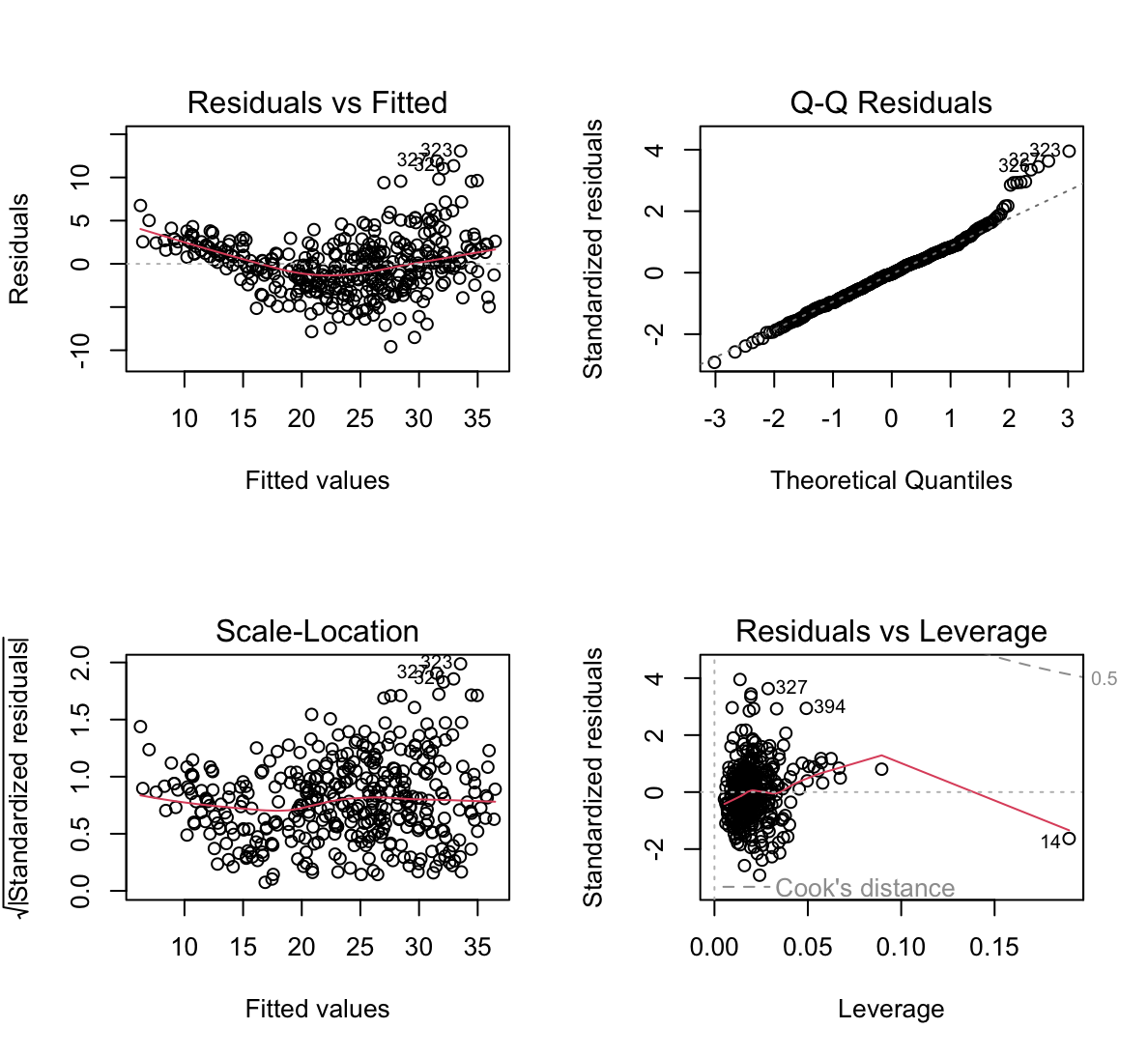
- Residuals vs Fitted - widać pewną zależność w kształcie litery U co mówi o tym, że dane nie są liniowe.
- Residuals v leverage - wskazuje, że obserwacja 14 ma duży wpływ na model.
- Scale-Location - wskazuje, że mogą występować pewne obserwacje odstające. Można je znaleźć używając komendy:
rstudent(mpg_all)[which(rstudent(mpg_all)>3)]245 323 326 327 3.390068 4.029537 3.494823 3.690246(e) Use the
*and:symbols to fit linear regression models with interaction effects. Do any interactions appear to be statistically significant?mpg_interaction = lm(mpg ~ . + year:cylinders + acceleration:horsepower + weight:displacement,data=Auto) summary(mpg_interaction)Call: lm(formula = mpg ~ . + year:cylinders + acceleration:horsepower + weight:displacement, data = Auto) Residuals: Min 1Q Median 3Q Max -8.4059 -1.5831 0.0088 1.2438 12.8486 Coefficients: Estimate Std. Error t value Pr(>|t|) (Intercept) -6.684e+01 1.153e+01 -5.796 1.43e-08 *** cylinders 1.078e+01 2.177e+00 4.953 1.10e-06 *** displacement -7.013e-02 1.055e-02 -6.651 1.01e-10 *** horsepower 2.725e-02 2.447e-02 1.114 0.26618 weight -8.598e-03 8.379e-04 -10.262 < 2e-16 *** acceleration 5.021e-01 1.531e-01 3.281 0.00113 ** year 1.462e+00 1.473e-01 9.929 < 2e-16 *** origin 5.099e-01 2.511e-01 2.031 0.04296 * cylinders:year -1.350e-01 2.799e-02 -4.824 2.04e-06 *** horsepower:acceleration -5.436e-03 1.732e-03 -3.138 0.00183 ** displacement:weight 1.852e-05 2.291e-06 8.087 8.25e-15 *** --- Signif. codes: 0 ‘***’ 0.001 ‘**’ 0.01 ‘*’ 0.05 ‘.’ 0.1 ‘ ’ 1 Residual standard error: 2.821 on 381 degrees of freedom Multiple R-squared: 0.8727, Adjusted R-squared: 0.8694 F-statistic: 261.2 on 10 and 381 DF, p-value: < 2.2e-16Dodanie interakcji zwiększyło wskaźnik R^2 adjusted czyli model jest lepiej dopasowany. Interakcje są istotne ponieważ ich $p$-value jest mniejszy od 0.05.
(f) Try a few different transformations of the variables, such as $\log(X)$, $\sqrt{X}$, $X^2$. Comment on your findings.
mpg_ope = lm(mpg ~ . + log(weight) + log(acceleration) + sqrt(displacement) + I(cylinders^2), data=Auto) summary(mpg_ope)Call: lm(formula = mpg ~ . + log(weight) + log(acceleration) + sqrt(displacement) + I(cylinders^2), data = Auto) Residuals: Min 1Q Median 3Q Max -10.0014 -1.6217 -0.1169 1.6178 12.5279 Coefficients: Estimate Std. Error t value Pr(>|t|) (Intercept) 293.415553 51.474048 5.700 2.40e-08 *** cylinders 0.960831 1.496776 0.642 0.52130 displacement 0.040087 0.032271 1.242 0.21493 horsepower -0.042899 0.013118 -3.270 0.00117 ** weight 0.007242 0.002314 3.130 0.00188 ** acceleration 1.989149 0.469850 4.234 2.89e-05 *** year 0.804299 0.045146 17.816 < 2e-16 *** origin 0.505488 0.270580 1.868 0.06251 . log(weight) -35.552480 7.175205 -4.955 1.09e-06 *** log(acceleration) -33.141292 7.682303 -4.314 2.05e-05 *** sqrt(displacement) -1.222754 0.987784 -1.238 0.21653 I(cylinders^2) -0.094503 0.122199 -0.773 0.43979 --- Signif. codes: 0 ‘***’ 0.001 ‘**’ 0.01 ‘*’ 0.05 ‘.’ 0.1 ‘ ’ 1 Residual standard error: 2.918 on 380 degrees of freedom Multiple R-squared: 0.8642, Adjusted R-squared: 0.8603 F-statistic: 219.8 on 11 and 380 DF, p-value: < 2.2e-16Nastąpiła poprawa modelu względem bazowego patrząc na R^2 adjusted ale transformacje
sqrt(displacement)icylinders^2są zbędne ponieważ ich $p$-value wynosi powyżej 0.05. -
This question should be answered using the
Carseatsdata set.(a) Fit a multiple regression model to predict
SalesusingPrice,Urban, andUS.library(ISLR) carseats_lm = lm(Sales~Price+Urban+US,data=Carseats) summary(carseats_lm)Call: lm(formula = Sales ~ Price + Urban + US, data = Carseats) Residuals: Min 1Q Median 3Q Max -6.9206 -1.6220 -0.0564 1.5786 7.0581 Coefficients: Estimate Std. Error t value Pr(>|t|) (Intercept) 13.043469 0.651012 20.036 < 2e-16 *** Price -0.054459 0.005242 -10.389 < 2e-16 *** UrbanYes -0.021916 0.271650 -0.081 0.936 USYes 1.200573 0.259042 4.635 4.86e-06 *** --- Signif. codes: 0 ‘***’ 0.001 ‘**’ 0.01 ‘*’ 0.05 ‘.’ 0.1 ‘ ’ 1 Residual standard error: 2.472 on 396 degrees of freedom Multiple R-squared: 0.2393, Adjusted R-squared: 0.2335 F-statistic: 41.52 on 3 and 396 DF, p-value: < 2.2e-16(b) Provide an interpretation of each coefficient in the model. Be careful — some of the variables in the model are qualitative!
- Intercept - reprezentuje średnią sprzedaż gdy inne zmienne są zaniedbywalne.
- Price - sprzedaż spada gdy cena rośnie.
- UrbanYes - sprzedaż spada gdy sklep jest w mieście.
- USYes - sprzedaż rośnie gdy sklep jest w USA.
(c) Write out the model in equation form, being careful to handle the qualitative variables properly.
contrasts(Carseats$Urban)Yes No 0 Yes 1contrasts(Carseats$US)Yes No 0 Yes 1\[Sales = \begin{cases} 13.04 - 0.05Price - 0.02 + 1.2 & \text{ gdy Urban = 1, US = 1} \\ 13.04 - 0.05Price - 0.02 & \text{ gdy Urban = 1, US = 0} \\ 13.04 - 0.05Price + 1.2 & \text{ gdy Urban = 0, US = 1} \\ 13.04 - 0.05Price & \text{ gdy Urban = 0, US = 0} \\ \end{cases}\]
(d) For which of the predictors can you reject the null hypothesis $H_0: \beta_j = 0$?
carseats_all = lm(Sales~.,data=Carseats) summary(carseats_all)Call: lm(formula = Sales ~ ., data = Carseats) Residuals: Min 1Q Median 3Q Max -2.8692 -0.6908 0.0211 0.6636 3.4115 Coefficients: Estimate Std. Error t value Pr(>|t|) (Intercept) 5.6606231 0.6034487 9.380 < 2e-16 *** CompPrice 0.0928153 0.0041477 22.378 < 2e-16 *** Income 0.0158028 0.0018451 8.565 2.58e-16 *** Advertising 0.1230951 0.0111237 11.066 < 2e-16 *** Population 0.0002079 0.0003705 0.561 0.575 Price -0.0953579 0.0026711 -35.700 < 2e-16 *** ShelveLocGood 4.8501827 0.1531100 31.678 < 2e-16 *** ShelveLocMedium 1.9567148 0.1261056 15.516 < 2e-16 *** Age -0.0460452 0.0031817 -14.472 < 2e-16 *** Education -0.0211018 0.0197205 -1.070 0.285 UrbanYes 0.1228864 0.1129761 1.088 0.277 USYes -0.1840928 0.1498423 -1.229 0.220 --- Signif. codes: 0 ‘***’ 0.001 ‘**’ 0.01 ‘*’ 0.05 ‘.’ 0.1 ‘ ’ 1 Residual standard error: 1.019 on 388 degrees of freedom Multiple R-squared: 0.8734, Adjusted R-squared: 0.8698 F-statistic: 243.4 on 11 and 388 DF, p-value: < 2.2e-16CompPrice,Income,Advertising,Price,ShelveLocGood,ShelveLocMedium,Age, opierając się na $p$-value > 0.05(e) On the basis of your response to the previous question, fit a smaller model that only uses the predictors for which there is evidence of association with the outcome.
carseats_lm2 = lm(Sales~.-Education-Urban-US-Population,data=Carseats) summary(carseats_lm2)Call: lm(formula = Sales ~ . - Education - Urban - US - Population, data = Carseats) Residuals: Min 1Q Median 3Q Max -2.7728 -0.6954 0.0282 0.6732 3.3292 Coefficients: Estimate Std. Error t value Pr(>|t|) (Intercept) 5.475226 0.505005 10.84 <2e-16 *** CompPrice 0.092571 0.004123 22.45 <2e-16 *** Income 0.015785 0.001838 8.59 <2e-16 *** Advertising 0.115903 0.007724 15.01 <2e-16 *** Price -0.095319 0.002670 -35.70 <2e-16 *** ShelveLocGood 4.835675 0.152499 31.71 <2e-16 *** ShelveLocMedium 1.951993 0.125375 15.57 <2e-16 *** Age -0.046128 0.003177 -14.52 <2e-16 *** --- Signif. codes: 0 ‘***’ 0.001 ‘**’ 0.01 ‘*’ 0.05 ‘.’ 0.1 ‘ ’ 1 Residual standard error: 1.019 on 392 degrees of freedom Multiple R-squared: 0.872, Adjusted R-squared: 0.8697 F-statistic: 381.4 on 7 and 392 DF, p-value: < 2.2e-16(f) How well do the models in (a) and (e) fit the data?
Statystyka $R^2$ adjusted wzrosła znacząco z 0.23 w (a) do 0.86 w (e). F-statistic również zwiększyło się. Oznacza to, że nowy model jest lepszy.
(g) Using the model from (e), obtain 95 % confidence intervals for the coefficient(s).
confint(carseats_lm2)2.5 % 97.5 % (Intercept) 4.48236820 6.46808427 CompPrice 0.08446498 0.10067795 Income 0.01217210 0.01939784 Advertising 0.10071856 0.13108825 Price -0.10056844 -0.09006946 ShelveLocGood 4.53585700 5.13549250 ShelveLocMedium 1.70550103 2.19848429 Age -0.05237301 -0.03988204(h) Is there evidence of outliers or high leverage observations in the model from (e)?
par(mfrow=c(2,2))
plot(carseats_lm2)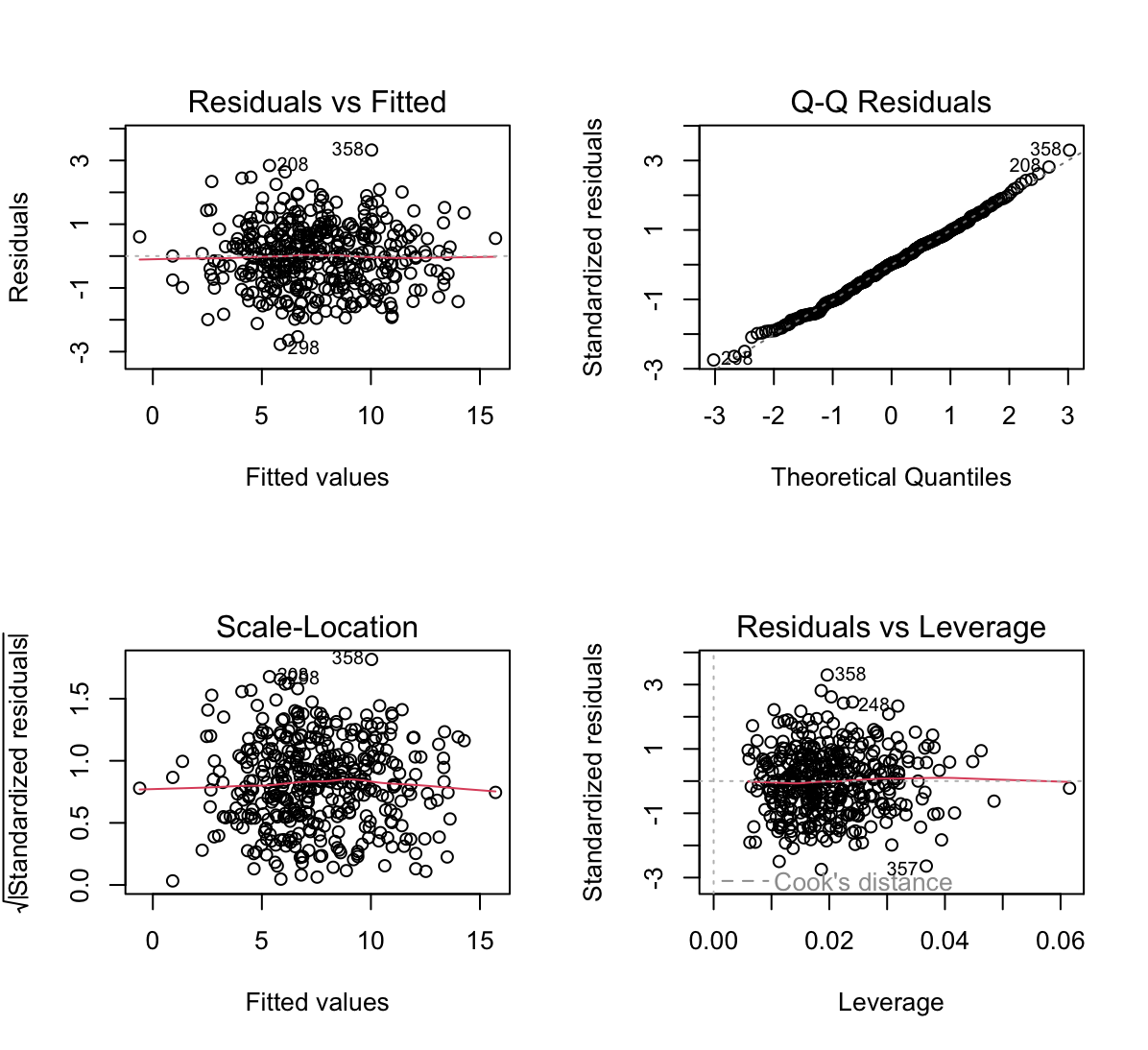
- Residuals v leverage - wskazuje, że jakaś obserwacja ma duży wpływ na model.
hatvalues(carseats_lm2)[order(hatvalues(carseats_lm2), decreasing = T)][1]311 0.06154635- Scale-Location - wskazuje, że mogą występować pewne obserwacje odstające.
rstudent(carseats_lm2)[which(rstudent(carseats_lm2)>3)]358 3.34075 -
In this problem we will investigate the t-statistic for the null hypothesis $H_0 : \beta = 0$ in simple linear regression without an intercept. To begin, we generate a predictor
xand a responseyas follows.set.seed(1) x <- rnorm(100) y <- 2 * x + rnorm(100)(a) Perform a simple linear regression of
yontox, without an intercept. Report the coefficient estimate $\hat{\beta}$, the standard error of this coefficient estimate, and the $t$-statistic and $p$-value associated with the null hypothesis $H_0 : \beta = 0$. Comment on these results. (You can perform regression without an intercept using the commandlm(y~x+0).)set.seed(1) x <- rnorm(100) y <- 2 * x + rnorm(100) lm.fit <- lm(y~x+0) summary(lm.fit)Call: lm(formula = y ~ x + 0) Residuals: Min 1Q Median 3Q Max -1.9154 -0.6472 -0.1771 0.5056 2.3109 Coefficients: Estimate Std. Error t value Pr(>|t|) x 1.9939 0.1065 18.73 <2e-16 *** --- Signif. codes: 0 ‘***’ 0.001 ‘**’ 0.01 ‘*’ 0.05 ‘.’ 0.1 ‘ ’ 1 Residual standard error: 0.9586 on 99 degrees of freedom Multiple R-squared: 0.7798, Adjusted R-squared: 0.7776 F-statistic: 350.7 on 1 and 99 DF, p-value: < 2.2e-16(b) Now perform a simple linear regression of
xontoywithout an intercept, and report the coefficient estimate, its standard error, and the corresponding $t$-statistic and $p$-values associated with the null hypothesis $H_0 : \beta = 0$. Comment on these results.lm.fit2 = lm(x~y+0) summary(lm.fit2)Call: lm(formula = x ~ y + 0) Residuals: Min 1Q Median 3Q Max -0.8699 -0.2368 0.1030 0.2858 0.8938 Coefficients: Estimate Std. Error t value Pr(>|t|) y 0.39111 0.02089 18.73 <2e-16 *** --- Signif. codes: 0 ‘***’ 0.001 ‘**’ 0.01 ‘*’ 0.05 ‘.’ 0.1 ‘ ’ 1 Residual standard error: 0.4246 on 99 degrees of freedom Multiple R-squared: 0.7798, Adjusted R-squared: 0.7776 F-statistic: 350.7 on 1 and 99 DF, p-value: < 2.2e-16(c) What is the relationship between the results obtained in (a) and (b)?
W modelu zostały zamienione osie więc statystyki testowe mają takie same wartości podobnie jak R-squared i Adjusted R-squared.
(d) For the regression of Y onto X without an intercept, the $t$-statistic for $H_0 : \beta = 0$ takes the form $\hat{\beta}/SE(\hat{\beta})$, where $\hat{\beta}$ is given by (3.38), and where
\[SE(\hat{\beta}) = \sqrt{\frac{\sum_{i=1}^n (y_i - x_i\hat{\beta})^2}{(n-1)\sum_{i'=1}^n x_{i'}^2}}\](These formulas are slightly different from those given in Sections 3.1.1 and 3.1.2, since here we are performing regression without an intercept.) Show algebraically, and confirm numerically in
R, that the $t$-statistic can be written as\[\frac{(\sqrt{n-1})\sum_{i=1}^n x_iy_i}{\sqrt{\left(\sum_{i=1}^n x_i^2\right)\left(\sum_{i'=1}^n y_{i'}^2\right) - \left(\sum_{i'=1}^n x_{i'}y_{i'}\right)^2}}\] \[\begin{aligned}t^2 &= \frac{\hat{\beta}^2}{SE^2(\hat{\beta})} = \frac{(n-1)\sum_{i'=1}^n x_{i'}^2\hat{\beta}^2}{\sum_{i=1}^n (y_i - x_i\hat{\beta})^2} = \\ &= \frac{(n-1)\sum_{i'=1}^n x_{i'}^2\hat{\beta}^2}{\sum_{i=1}^n (y_i^2 - 2y_ix_i\hat{\beta} + x_i^2\hat{\beta}^2)} = \\ &= \frac{(n-1)\sum_{i'=1}^n x_{i'}^2\hat{\beta}^2}{\sum_{i=1}^ny_i^2 - 2\sum_{i=1}^ny_ix_i\hat{\beta} + \sum_{i=1}^nx_i^2\hat{\beta}^2} = \\ &= \frac{(n-1)\sum_{i'=1}^n x_{i'}^2\frac{\left(\sum_{i=1}^nx_iy_i \right)^2}{\left(\sum_{i'=1}^nx_{i'}^2 \right)^2}}{\sum_{i=1}^ny_i^2 - 2\sum_{i=1}^ny_ix_i\frac{\sum_{i=1}^nx_iy_i}{\sum_{i'=1}^nx_{i'}^2} + \sum_{i=1}^nx_i^2\frac{\left(\sum_{i=1}^nx_iy_i \right)^2}{\left(\sum_{i'=1}^nx_{i'}^2 \right)^2}} = \\ &= \frac{(n-1)\frac{\left(\sum_{i=1}^nx_iy_i \right)^2}{\sum_{i'=1}^nx_{i'}^2}}{\frac{\sum_{i'=1}^nx_{i'}^2\sum_{i=1}^ny_i^2}{\sum_{i'=1}^nx_{i'}^2} - 2\frac{\left(\sum_{i=1}^nx_iy_i\right)^2}{\sum_{i'=1}^nx_{i'}^2} + \frac{\left(\sum_{i=1}^nx_iy_i \right)^2}{\sum_{i'=1}^nx_{i'}^2}} = \\ &= \frac{(n-1)\frac{\left(\sum_{i=1}^nx_iy_i \right)^2}{\sum_{i'=1}^nx_{i'}^2}}{\frac{\sum_{i'=1}^nx_{i'}^2\sum_{i=1}^ny_i^2}{\sum_{i'=1}^nx_{i'}^2} - \frac{\left(\sum_{i=1}^nx_iy_i\right)^2}{\sum_{i'=1}^nx_{i'}^2}} = \\ &= \frac{(n-1)\left(\sum_{i=1}^nx_iy_i \right)^2}{\sum_{i'=1}^nx_{i'}^2\sum_{i=1}^ny_i^2 - \left(\sum_{i=1}^nx_iy_i\right)^2}\end{aligned}\] \[t = \frac{(\sqrt{n-1})\sum_{i=1}^n x_iy_i}{\sqrt{\left(\sum_{i'=1}^n x_{i'}^2\right)\left(\sum_{i=1}^n y_{i}^2\right) - \left(\sum_{i=1}^n x_{i}y_{i'}\right)^2}}\]
numerator = sqrt(length(x)-1)*sum(x*y) denumerator = sqrt(sum(x^2)*sum(y^2) - sum(x*y)^2) t_statistic = numerator/denumerator t_statistic[1] 18.72593Wyszło tyle co w modelu.
(e) Using the results from (d), argue that the $t$-statistic for the regression of
yontoxis the same as the $t$-statistic for the regression ofxontoy.Widać od razu, że zamiana
xzyda ten sam wzór końcowy.(f) In
R, show that when regression is performed with an intercept, the $t$-statistic for $H_0 : \beta_1 = 0$ is the same for the regression ofyontoxas it is for the regression ofxontoy.lm.fit3 = lm(y~x) summary(lm.fit3)$coefficients[2,3][1] 18.5556lm.fit4 = lm(x~y) summary(lm.fit4)$coefficients[2,3][1] 18.5556 -
This problem involves simple linear regression without an intercept.
(a) Recall that the coefficient estimate $\hat{\beta}$ for the linear regression of $Y$ onto $X$ without an intercept is given by (3.38). Under what circumstance is the coefficient estimate for the regression of $X$ onto $Y$ the same as the coefficient estimate for the regression of $Y$ onto $X$?
\[\hat{\beta}_x = \frac{\sum_{i=1}^nx_iy_i}{\sum_{i=1}^nx_i^2}\] \[\hat{\beta}_y = \frac{\sum_{i=1}^nx_iy_i}{\sum_{i=1}^ny_i^2}\] \[\hat{\beta}_x = \hat{\beta}_y, \text{ gdy: } \sum_{i=1}^nx_i^2 = \sum_{i=1}^ny_i^2\]
(b) Generate an example in
Rwith $n = 100$ observations in which the coefficient estimate for the regression of $X$ onto $Y$ is different from the coefficient estimate for the regression of $Y$ onto $X$.set.seed(1) x <- rnorm(100) y <- 2 * x + rnorm(100)(c) Generate an example in
Rwith $n = 100$ observations in which the coefficient estimate for the regression of $X$ onto $Y$ is the same as the coefficient estimate for the regression of $Y$ onto $X$.set.seed(1) x <- rnorm(100) y <- sample(x) # sample miesza liczby z x, lepiej widać, # że wystarczy, że suma obserwacji jest # równa żeby dostać ten sam współczynnik -
In this exercise you will create some simulated data and will fit simple linear regression models to it. Make sure to use
set.seed(1)prior to starting part (a) to ensure consistent results.(a) Using the
rnorm()function, create a vector,x, containing 100 observations drawn from a $N(0,1)$ distribution. This represents a feature, $X$.set.seed(1) x <- rnorm(100, mean=0, sd=1)(b) Using the
rnorm()function, create a vector,eps, containing 100 observations drawn from a $N(0,0.25)$ distribution—a normal distribution with mean zero and variance 0.25 .eps <- rnorm(100, mean=0, sd=0.5)(c) Using
\[Y=-1+0.5 X+\epsilon\]xandeps, generate a vectoryaccording to the modelWhat is the length of the vector
y? What are the values of $\beta_0$ and $\beta_1$ in this linear model?y = -1 + (0.5 * x) + epsDługość wektora to 100. $\beta_0 = -1$, $\beta_1 = 0.5$
(d) Create a scatterplot displaying the relationship between
xandy. Comment on what you observe.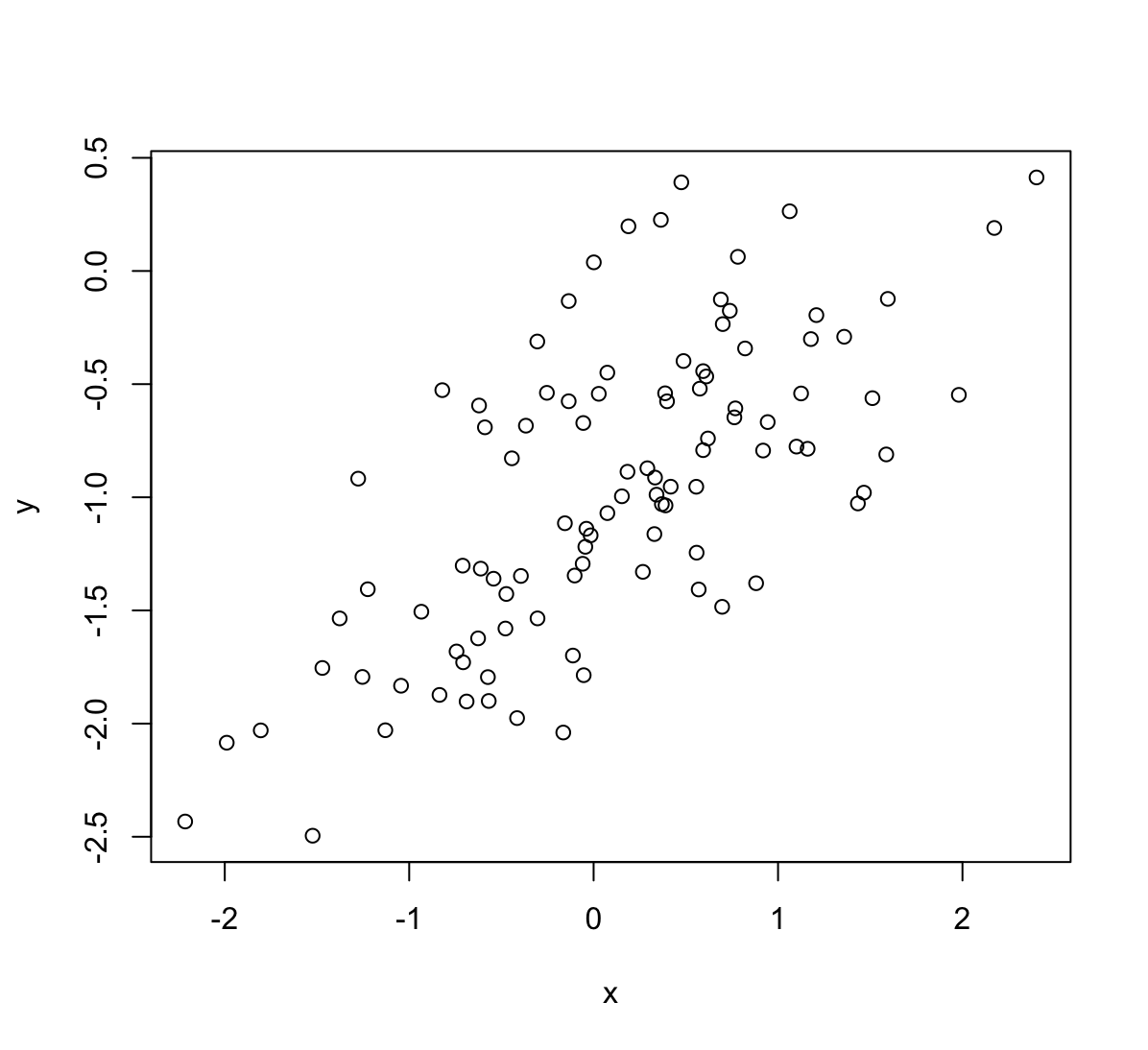
Widać pewną liniową zależność.
(e) Fit a least squares linear model to predict
yusingx. Comment on the model obtained. How do $\hat{\beta}_0$ and $\hat{\beta}_1$ compare to $\beta_0$ and $\beta_1$?lm.fit <- lm(y~x) summary(lm.fit)Call: lm(formula = y ~ x) Residuals: Min 1Q Median 3Q Max -0.93842 -0.30688 -0.06975 0.26970 1.17309 Coefficients: Estimate Std. Error t value Pr(>|t|) (Intercept) -1.01885 0.04849 -21.010 < 2e-16 *** x 0.49947 0.05386 9.273 4.58e-15 *** --- Signif. codes: 0 ‘***’ 0.001 ‘**’ 0.01 ‘*’ 0.05 ‘.’ 0.1 ‘ ’ 1 Residual standard error: 0.4814 on 98 degrees of freedom Multiple R-squared: 0.4674, Adjusted R-squared: 0.4619 F-statistic: 85.99 on 1 and 98 DF, p-value: 4.583e-15$\hat{\beta}_0$, $\hat{\beta}_1$ porównując do $\beta_0$, $\beta_1$ mają nieco inną wartość co jest spowodowane czynnikiem błędu
eps, który występuje w danych.(f) Display the least squares line on the scatterplot obtained in (d). Draw the population regression line on the plot, in a different color. Use the
legend()command to create an appropriate legend.abline(lm.fit, lwd=1, col ="blue") abline(a=-1, b=0.5, lwd=1, col="red") legend('bottomright', legend=c('Least Squares Line', 'Population Line'), col=c('blue','red'), lty = c(1, 1))
(g) Now fit a polynomial regression model that predicts
yusingxand $x^2$. Is there evidence that the quadratic term improves the model fit? Explain your answer.lm.fit2 = lm(y~x+I(x^2)) summary(lm.fit2)Call: lm(formula = y ~ x + I(x^2)) Residuals: Min 1Q Median 3Q Max -0.98252 -0.31270 -0.06441 0.29014 1.13500 Coefficients: Estimate Std. Error t value Pr(>|t|) (Intercept) -0.97164 0.05883 -16.517 < 2e-16 *** x 0.50858 0.05399 9.420 2.4e-15 *** I(x^2) -0.05946 0.04238 -1.403 0.164 --- Signif. codes: 0 ‘***’ 0.001 ‘**’ 0.01 ‘*’ 0.05 ‘.’ 0.1 ‘ ’ 1 Residual standard error: 0.479 on 97 degrees of freedom Multiple R-squared: 0.4779, Adjusted R-squared: 0.4672 F-statistic: 44.4 on 2 and 97 DF, p-value: 2.038e-14Brak poprawy, statystyka F ma mniejszą wartość, $p$-value prze członie kwadratowym jest większe od 0.05 co oznacza, że nie jest to potrzebne w modelu.
(h) Repeat (a)-(f) after modifying the data generation process in such a way that there is less noise in the data. The model $Y=-1+0.5 X+\epsilon$ should remain the same. You can do this by decreasing the variance of the normal distribution used to generate the error term $\epsilon$ in (b). Describe your results.
set.seed(1) x <- rnorm(100, mean=0, sd=1) eps <- rnorm(100, mean=0, sd=0.1) y = -1 +(0.5*x) + eps lm.fit3 <- lm(y~x) summary(lm.fit3)Call: lm(formula = y ~ x) Residuals: Min 1Q Median 3Q Max -0.18768 -0.06138 -0.01395 0.05394 0.23462 Coefficients: Estimate Std. Error t value Pr(>|t|) (Intercept) -1.003769 0.009699 -103.5 <2e-16 *** x 0.499894 0.010773 46.4 <2e-16 *** --- Signif. codes: 0 ‘***’ 0.001 ‘**’ 0.01 ‘*’ 0.05 ‘.’ 0.1 ‘ ’ 1 Residual standard error: 0.09628 on 98 degrees of freedom Multiple R-squared: 0.9565, Adjusted R-squared: 0.956 F-statistic: 2153 on 1 and 98 DF, p-value: < 2.2e-16plot(x, y) abline(lm.fit3, lwd=1, col ="blue") abline(a=-1, b=0.5, lwd=1, col="red") legend('bottomright', legend=c('Least Squares Line', 'Population Line'), col=c('blue','red'), lty = c(1, 1))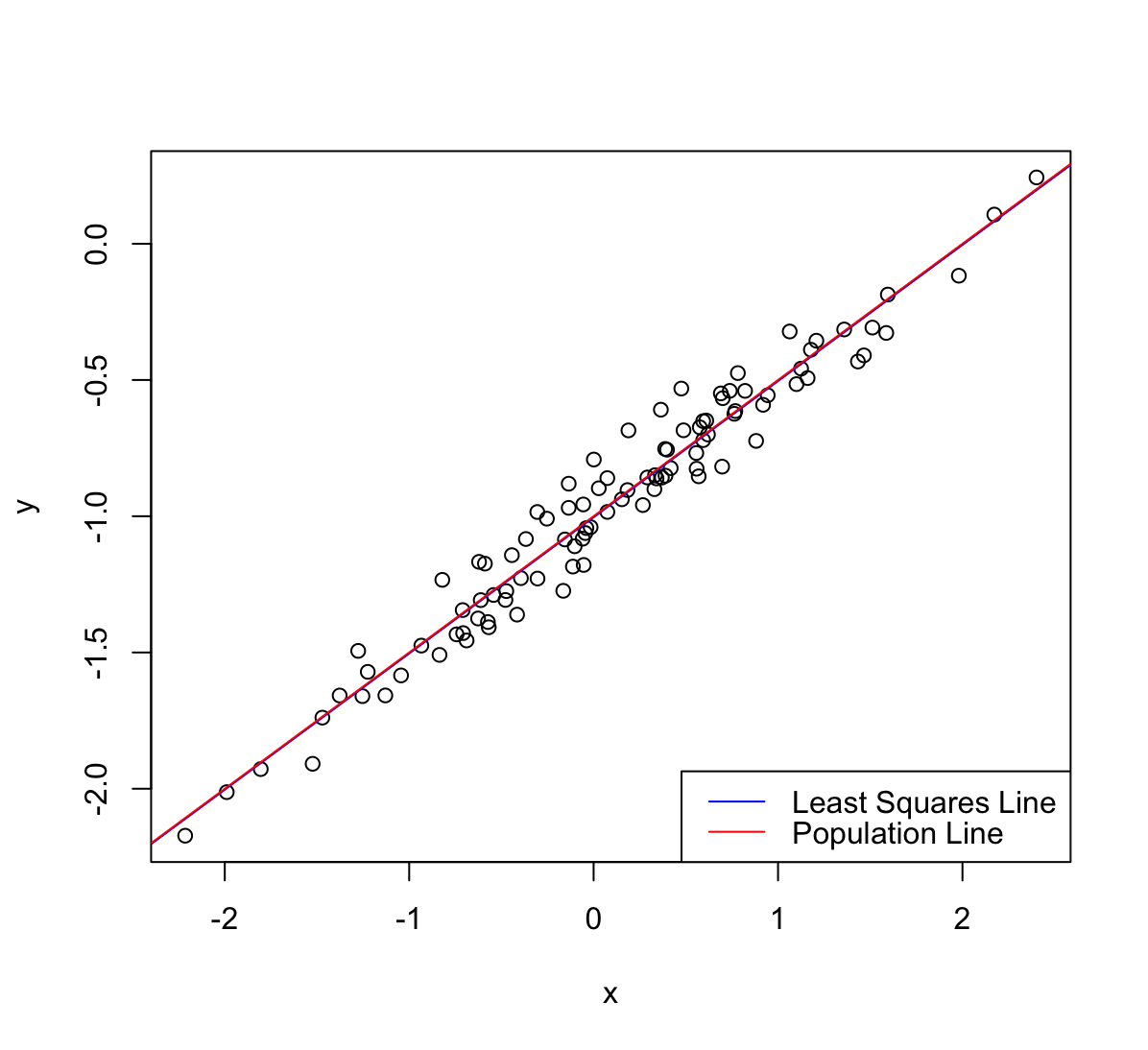
Punkt są mniej rozrzucone dzięki czemu model regresji jest lepiej dopasowany.
(i) Repeat (a)-(f) after modifying the data generation process in such a way that there is more noise in the data. The model $Y=-1+0.5 X+\epsilon$ should remain the same. You can do this by increasing the variance of the normal distribution used to generate the error term $\epsilon$ in (b). Describe your results.
set.seed(1) x <- rnorm(100, mean=0, sd=1) eps <- rnorm(100, mean=0, sd=1) y = -1 +(0.5*x) + eps lm.fit4 <- lm(y~x) summary(lm.fit4)Call: lm(formula = y ~ x) Residuals: Min 1Q Median 3Q Max -1.8768 -0.6138 -0.1395 0.5394 2.3462 Coefficients: Estimate Std. Error t value Pr(>|t|) (Intercept) -1.03769 0.09699 -10.699 < 2e-16 *** x 0.49894 0.10773 4.632 1.12e-05 *** --- Signif. codes: 0 ‘***’ 0.001 ‘**’ 0.01 ‘*’ 0.05 ‘.’ 0.1 ‘ ’ 1 Residual standard error: 0.9628 on 98 degrees of freedom Multiple R-squared: 0.1796, Adjusted R-squared: 0.1712 F-statistic: 21.45 on 1 and 98 DF, p-value: 1.117e-05plot(x, y) abline(lm.fit4, lwd=1, col ="blue") abline(a=-1, b=0.5, lwd=1, col="red") legend('bottomright', legend=c('Least Squares Line', 'Population Line'), col=c('blue','red'), lty = c(1, 1))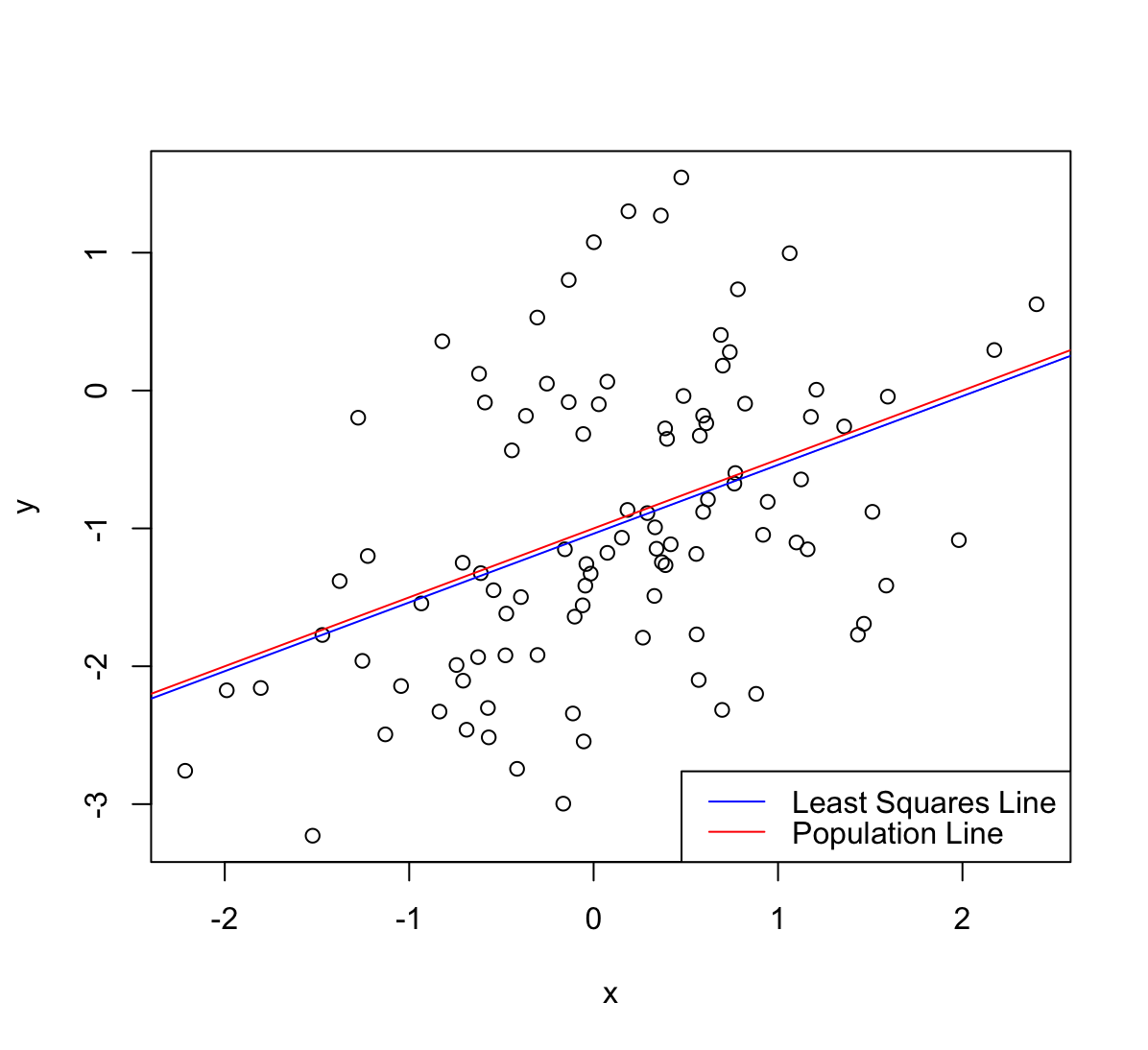
Punkt są bardziej rozrzucone przez co model regresji jest gorzej dopasowany.
(j) What are the confidence intervals for $\beta_0$ and $\beta_1$ based on the original data set, the noisier data set, and the less noisy data set? Comment on your results.
confint(lm.fit)2.5 % 97.5 % (Intercept) -1.1150804 -0.9226122 x 0.3925794 0.6063602confint(lm.fit3)2.5 % 97.5 % (Intercept) -1.0230161 -0.9845224 x 0.4785159 0.5212720confint(lm.fit4)2.5 % 97.5 % (Intercept) -1.2301607 -0.8452245 x 0.2851588 0.7127204Oczywistością jest, że przedziały są węższe w lepiej dopasowanym modelu.
-
This problem focuses on the collinearity problem.
(a) Perform the following commands in
R:set.seed(1) x1 <- runif(100) x2 <- 0.5 * x1 + rnorm(100) / 10 y <- 2 + 2 * x1 + 0.3 * x2 + rnorm(100)The last line corresponds to creating a linear model in which
yis a function ofx1andx2. Write out the form of the linear model. What are the regression coefficients?\[Y = 2 + 2x_1 + 0.3x_2 + \epsilon, \text{ gdzie } \epsilon ~ N(0,1)\]
\[\beta_0 = 2, \beta_1 = 2, \beta_2 = 0.3\]
(b) What is the correlation between
x1andx2? Create a scatterplot displaying the relationship between the variables.cor(x1, x2)[1] 0.8351212plot(x1, x2)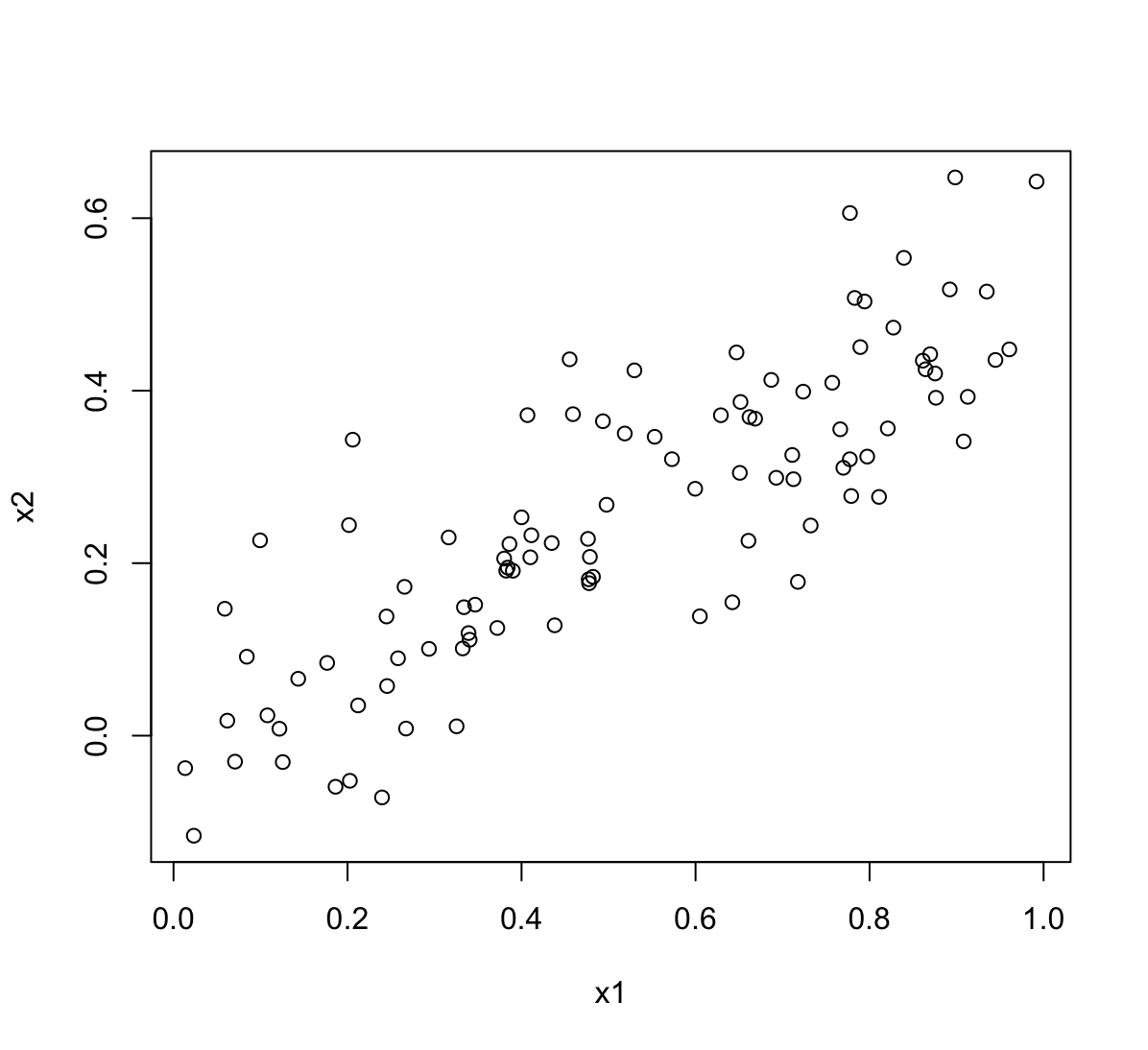
(c) Using this data, fit a least squares regression to predict
yusingx1andx2. Describe the results obtained. What are $\hat{\beta}_0, \hat{\beta}_1$, and $\hat{\beta}_2$? How do these relate to the true $\beta_0, \beta_1$, and $\beta_2$? Can you reject the null hypothesis $H_0 : \beta_1=0$ ? How about the null hypothesis $H_0 : \beta_2=0$?lm.fit <- lm(y~x1+x2) summary(lm.fit)Call: lm(formula = y ~ x1 + x2) Residuals: Min 1Q Median 3Q Max -2.8311 -0.7273 -0.0537 0.6338 2.3359 Coefficients: Estimate Std. Error t value Pr(>|t|) (Intercept) 2.1305 0.2319 9.188 7.61e-15 *** x1 1.4396 0.7212 1.996 0.0487 * x2 1.0097 1.1337 0.891 0.3754 --- Signif. codes: 0 ‘***’ 0.001 ‘**’ 0.01 ‘*’ 0.05 ‘.’ 0.1 ‘ ’ 1 Residual standard error: 1.056 on 97 degrees of freedom Multiple R-squared: 0.2088, Adjusted R-squared: 0.1925 F-statistic: 12.8 on 2 and 97 DF, p-value: 1.164e-05$\hat{\beta}_0 = 2.13, \hat{\beta}_1 = 1.43, \hat{\beta}_2 = 1.01$, współczynniki z dopasowania regresji odbiegają od tych z modelu linowego. $p$-value dla $\hat{\beta}_2$ jest większe od 0.05 więc ta zmienna nie powinna być w modelu regresji.
(d) Now fit a least squares regression to predict
yusing onlyx1. Comment on your results. Can you reject the null hypothesis $H_0 : \beta_1=0$?lm.fit2 <- lm(y~x1) summary(lm.fit2)Call: lm(formula = y ~ x1) Residuals: Min 1Q Median 3Q Max -2.89495 -0.66874 -0.07785 0.59221 2.45560 Coefficients: Estimate Std. Error t value Pr(>|t|) (Intercept) 2.1124 0.2307 9.155 8.27e-15 *** x1 1.9759 0.3963 4.986 2.66e-06 *** --- Signif. codes: 0 ‘***’ 0.001 ‘**’ 0.01 ‘*’ 0.05 ‘.’ 0.1 ‘ ’ 1 Residual standard error: 1.055 on 98 degrees of freedom Multiple R-squared: 0.2024, Adjusted R-squared: 0.1942 F-statistic: 24.86 on 1 and 98 DF, p-value: 2.661e-06- Można odrzucić hipotezę ponieważ $p$-value jest bliskie zera
- Statystyka $R^2$ jest podobna do poprzedniego przypadku ale statystyka F jest teraz większa.
(e) Now fit a least squares regression to predict
yusing onlyx2. Comment on your results. Can you reject the null hypothesis $H_0 : \beta_1=0$?lm.fit3 <- lm(y~x2) summary(lm.fit3)Call: lm(formula = y ~ x2) Residuals: Min 1Q Median 3Q Max -2.62687 -0.75156 -0.03598 0.72383 2.44890 Coefficients: Estimate Std. Error t value Pr(>|t|) (Intercept) 2.3899 0.1949 12.26 < 2e-16 *** x2 2.8996 0.6330 4.58 1.37e-05 *** --- Signif. codes: 0 ‘***’ 0.001 ‘**’ 0.01 ‘*’ 0.05 ‘.’ 0.1 ‘ ’ 1 Residual standard error: 1.072 on 98 degrees of freedom Multiple R-squared: 0.1763, Adjusted R-squared: 0.1679 F-statistic: 20.98 on 1 and 98 DF, p-value: 1.366e-05- Można odrzucić hipotezę ponieważ $p$-value jest bliskie zera
- Statystyka $R^2$ jest niższa niż w poprzednich przypadkach. Statystyka F jest teraz pomiędzy.
(f) Do the results obtained in (c)-(e) contradict each other? Explain your answer.
Nie, wyniki w modelach (c)-(e) nie przeczą sobie i mogą być wyjaśnione na podstawie kolinearności. Kiedy dwie zmienne w modelu są ze sobą związane liniowo wpływ jednej z nich na zmienną objaśnianą może być zaburzony przez drugą ze zmiennych. Kolinearność zwiększa również błąd standardowy, z modeli wynika, że błąd
x1+x2jest większy niż błąd dlaxlubx2.(g) Now suppose we obtain one additional observation, which was unfortunately mismeasured.
x1 <- c(x1, 0.1)
x2 <- c(x2, 0.8)
y <- c(y, 6)
Re-fit the linear models from (c) to (e) using this new data. What effect does this new observation have on the each of the models? In each model, is this observation an outlier? A high-leverage point? Both? Explain your answers.
par(mfrow=c(2,2))
lm.fit <- lm(y~x1+x2)
plot(lm.fit)
rstudent(lm.fit)[which(rstudent(lm.fit)>3)]
named numeric(0)hatvalues(lm.fit)[order(hatvalues(lm.fit), decreasing = T)][1]101 0.4147284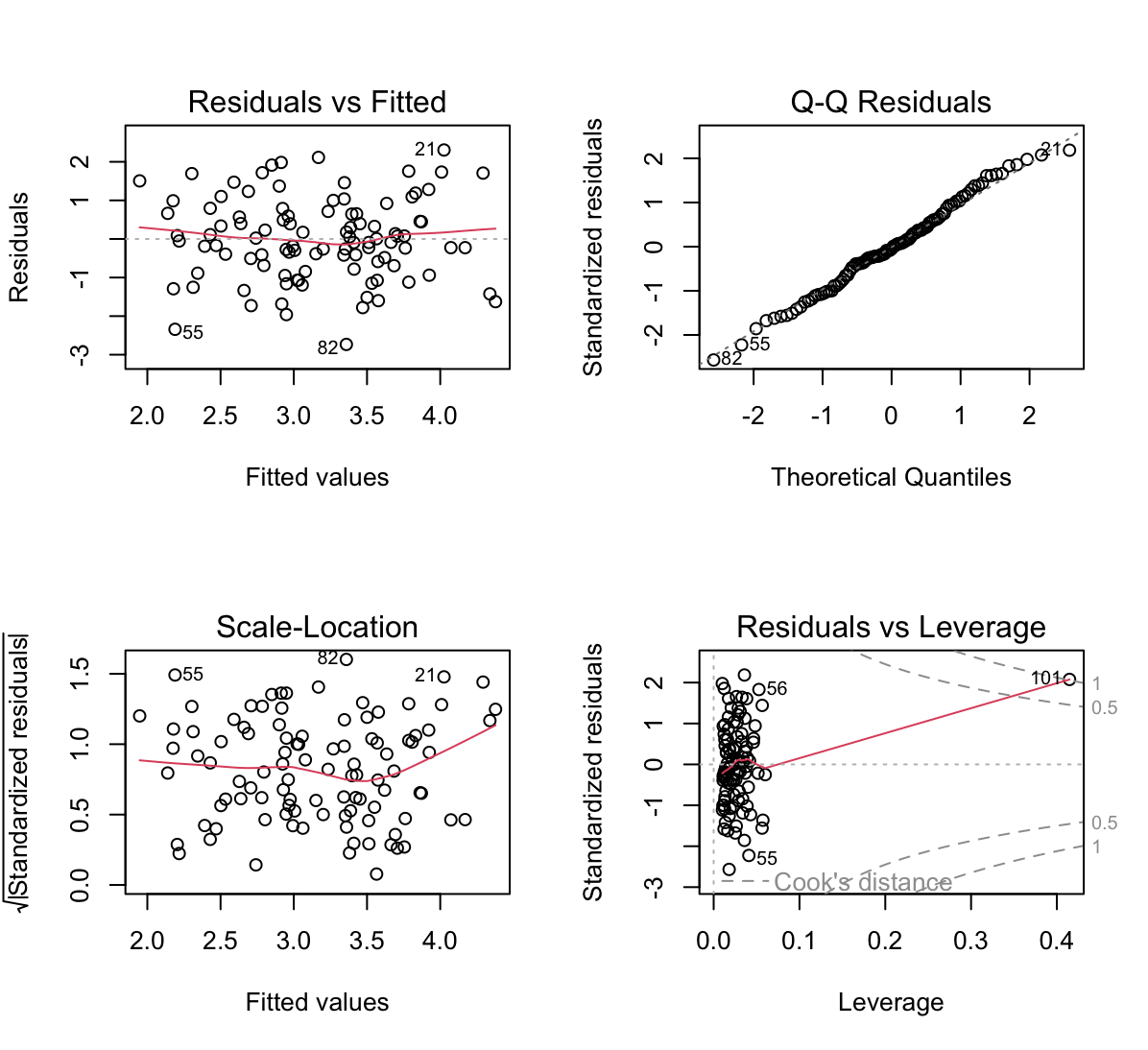
W tym modelu nowy punkt (101) jest punktem wpływowym ale nie jest obserwacją odstającą.
lm.fit2 <- lm(y~x1)
plot(lm.fit2)
rstudent(lm.fit2)[which(rstudent(lm.fit2)>3)]
101 3.438405hatvalues(lm.fit2)[order(hatvalues(lm.fit2), decreasing = T)][1]27 0.04437352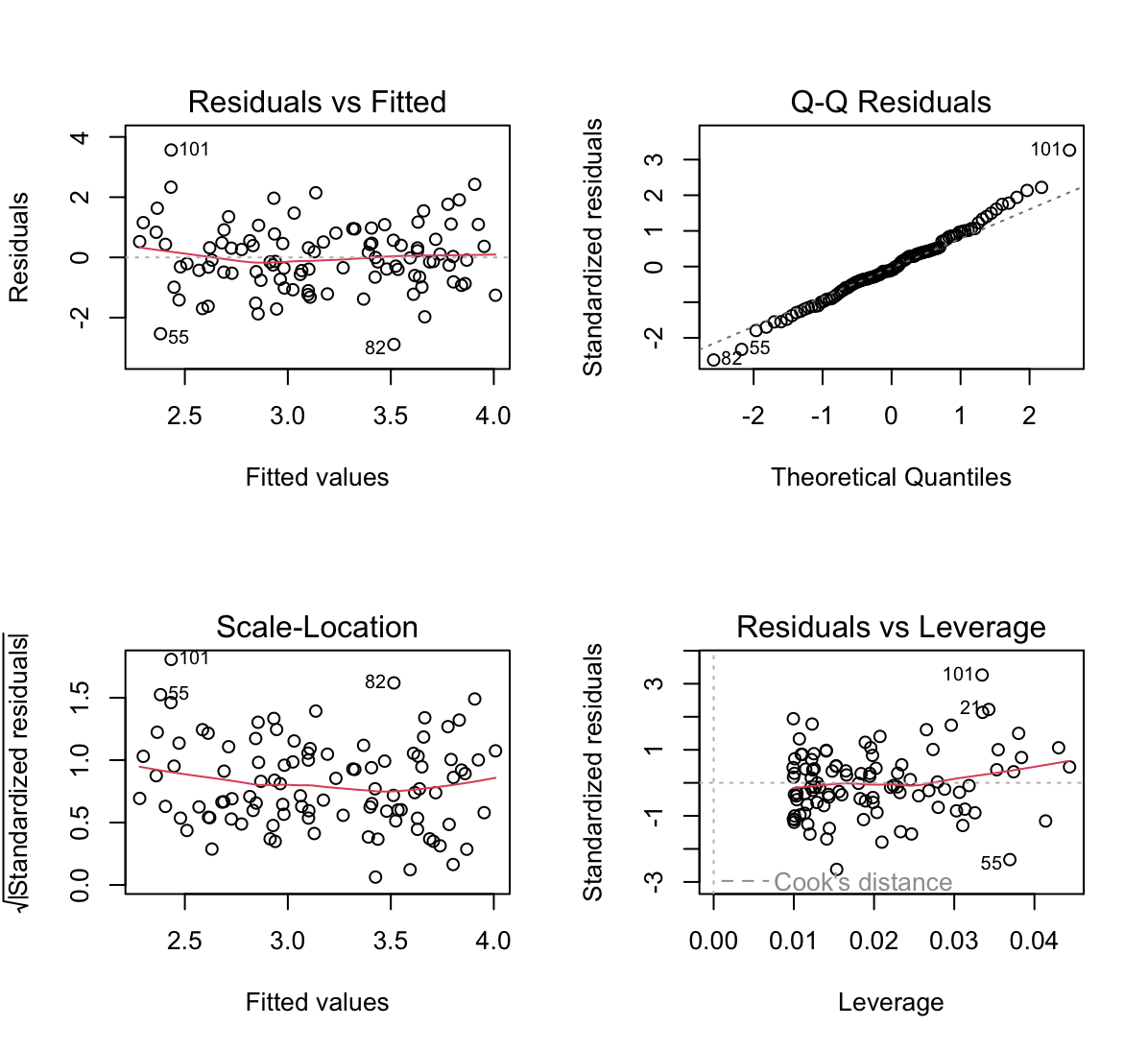
W tym modelu nowy punkt (101) jest punktem odstającym ale nie jest punktem wpływowym. Punkt 27 jest wpływowy.
lm.fit3 <- lm(y~x2)
plot(lm.fit3)
rstudent(lm.fit3)[which(rstudent(lm.fit3)>3)]
named numeric(0)hatvalues(lm.fit3)[order(hatvalues(lm.fit3), decreasing = T)][1]101 0.1013106W tym modelu nowy punkt (101) jest punktem wpływowym ale nie jest obserwacją odstającą.
-
This problem involves the
Bostondata set, which we saw in the lab for this chapter. We will now try to predict per capita crime rate using the other variables in this data set. In other words, per capita crime rate is the response, and the other variables are the predictors.(a) For each predictor, fit a simple linear regression model to predict the response. Describe your results. In which of the models is there a statistically significant association between the predictor and the response? Create some plots to back up your assertions.
library(MASS)
head(Boston)
crim zn indus chas nox rm age dis rad tax ptratio black lstat medv 1 0.00632 18 2.31 0 0.538 6.575 65.2 4.0900 1 296 15.3 396.90 4.98 24.0 2 0.02731 0 7.07 0 0.469 6.421 78.9 4.9671 2 242 17.8 396.90 9.14 21.6 3 0.02729 0 7.07 0 0.469 7.185 61.1 4.9671 2 242 17.8 392.83 4.03 34.7 4 0.03237 0 2.18 0 0.458 6.998 45.8 6.0622 3 222 18.7 394.63 2.94 33.4 5 0.06905 0 2.18 0 0.458 7.147 54.2 6.0622 3 222 18.7 396.90 5.33 36.2 6 0.02985 0 2.18 0 0.458 6.430 58.7 6.0622 3 222 18.7 394.12 5.21 28.7columns = colnames(Boston) columns = columns[-1] # usunięcie zmiennej crim p_values = c() r_squared = c() for (x in columns) { lm = lm(paste("crim", "~", x), data=Boston) p_values = c(p_values, summary(lm)$coefficients[2,4]) r_squared = c(r_squared, summary(lm)$r.squared) } results = data.frame(row.names = columns) results$p_values = p_values results$r_squared = r_squared print(results)p_values r_squared zn 5.506472e-06 0.040187908 indus 1.450349e-21 0.165310070 chas 2.094345e-01 0.003123869 nox 3.751739e-23 0.177217182 rm 6.346703e-07 0.048069117 age 2.854869e-16 0.124421452 dis 8.519949e-19 0.144149375 rad 2.693844e-56 0.391256687 tax 2.357127e-47 0.339614243 ptratio 2.942922e-11 0.084068439 black 2.487274e-19 0.148274239 lstat 2.654277e-27 0.207590933 medv 1.173987e-19 0.150780469print(results[results$p_values > 0.05, ])p_values r_squared chas 0.2094345 0.003123869Tylko dla zmiennej
chas$p$-value jest powyżej 0.05 dlatego na tej podstawie nie można zbudować modelu liniowego.Wszystkie modele są słabo dopasowane o czym mówią niskie wartości statystyki $R^2$.
lm.fit = lm(crim~rad, data=Boston)
plot(Boston$crim, Boston$rad)
abline(lm.fit, col="blue", lwd=3)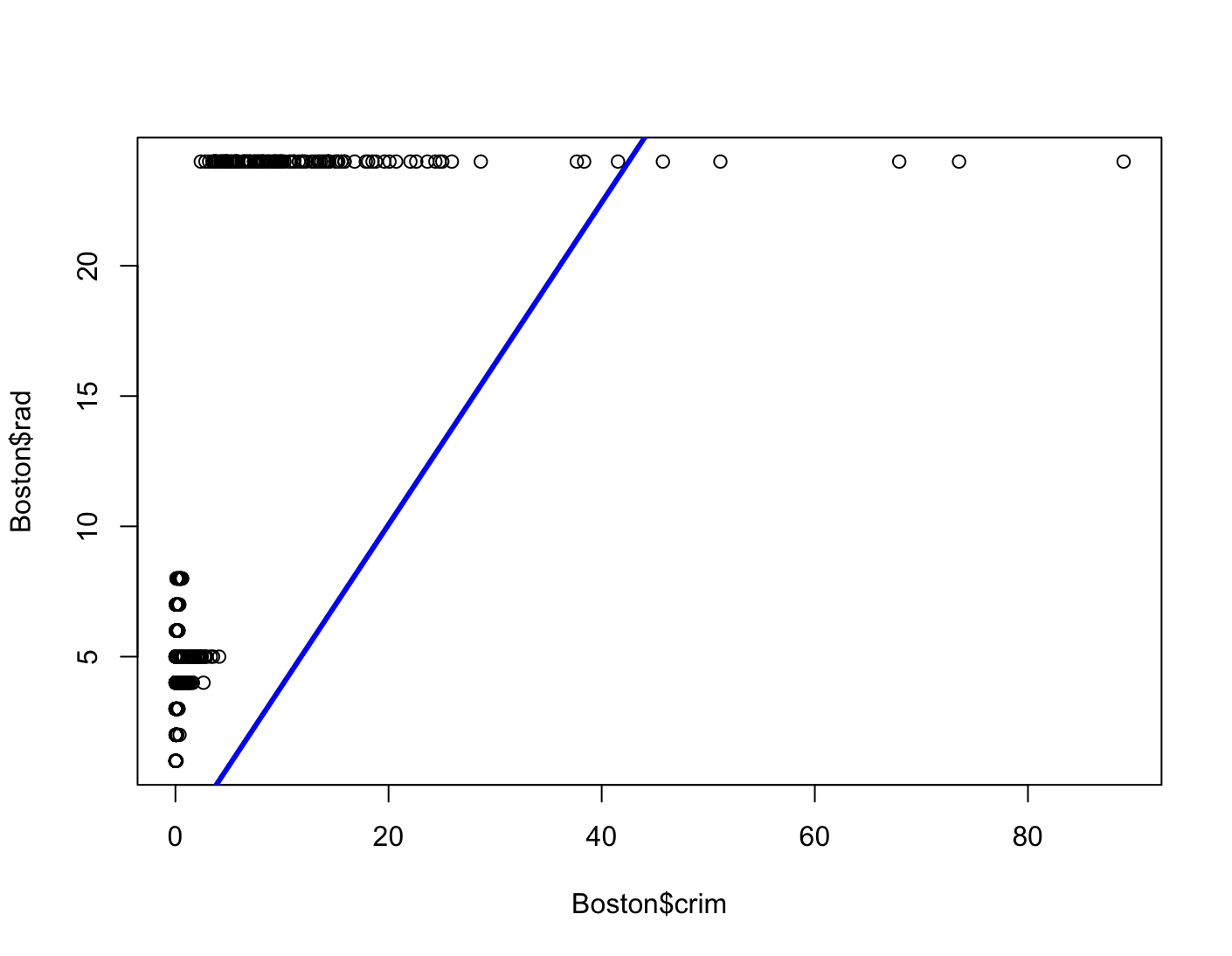
Dla najlepiej dopasowanego modelu dostajemy bezsensowną linię. Patrząc na wykresy
crimod innych zmiennych nie widać zależności liniowej w żadnym modelu.(b) Fit a multiple regression model to predict the response using all of the predictors. Describe your results. For which predictors can we reject the null hypothesis $H_0 : \beta_j=0$?
lm.fit2 = lm(crim ~ ., data=Boston) summary(lm.fit2)Call: lm(formula = crim ~ ., data = Boston) Residuals: Min 1Q Median 3Q Max -9.924 -2.120 -0.353 1.019 75.051 Coefficients: Estimate Std. Error t value Pr(>|t|) (Intercept) 17.033228 7.234903 2.354 0.018949 * zn 0.044855 0.018734 2.394 0.017025 * indus -0.063855 0.083407 -0.766 0.444294 chas -0.749134 1.180147 -0.635 0.525867 nox -10.313535 5.275536 -1.955 0.051152 . rm 0.430131 0.612830 0.702 0.483089 age 0.001452 0.017925 0.081 0.935488 dis -0.987176 0.281817 -3.503 0.000502 *** rad 0.588209 0.088049 6.680 6.46e-11 *** tax -0.003780 0.005156 -0.733 0.463793 ptratio -0.271081 0.186450 -1.454 0.146611 black -0.007538 0.003673 -2.052 0.040702 * lstat 0.126211 0.075725 1.667 0.096208 . medv -0.198887 0.060516 -3.287 0.001087 ** --- Signif. codes: 0 ‘***’ 0.001 ‘**’ 0.01 ‘*’ 0.05 ‘.’ 0.1 ‘ ’ 1 Residual standard error: 6.439 on 492 degrees of freedom Multiple R-squared: 0.454, Adjusted R-squared: 0.4396 F-statistic: 31.47 on 13 and 492 DF, p-value: < 2.2e-16indus,chas,nox,rm,age,tax,ptratio,lstatponieważ $p$-value jest większe od 0.05(c) How do your results from (a) compare to your results from (b)? Create a plot displaying the univariate regression coefficients from (a) on the $x$-axis, and the multiple regression coefficients from (b) on the $y$-axis. That is, each predictor is displayed as a single point in the plot. Its coefficient in a simple linear regression model is shown on the $x$-axis, and its coefficient estimate in the multiple linear regression model is shown on the $y$-axis.
simple_coefs = c()
multip_coefs = c()
for (x in columns) {
  lm = lm(paste("crim", "~", x), data=Boston)
  simple_coefs = c(simple_coefs, summary(lm)$coefficients[2,1])
  multip_coefs = c(multip_coefs, summary(lm.fit2)$coefficients[-1,1][x])
}
plot(simple_coefs, multip_coefs, xlab="Simple regression coeffs",
     ylab="Multiple regression coeffs")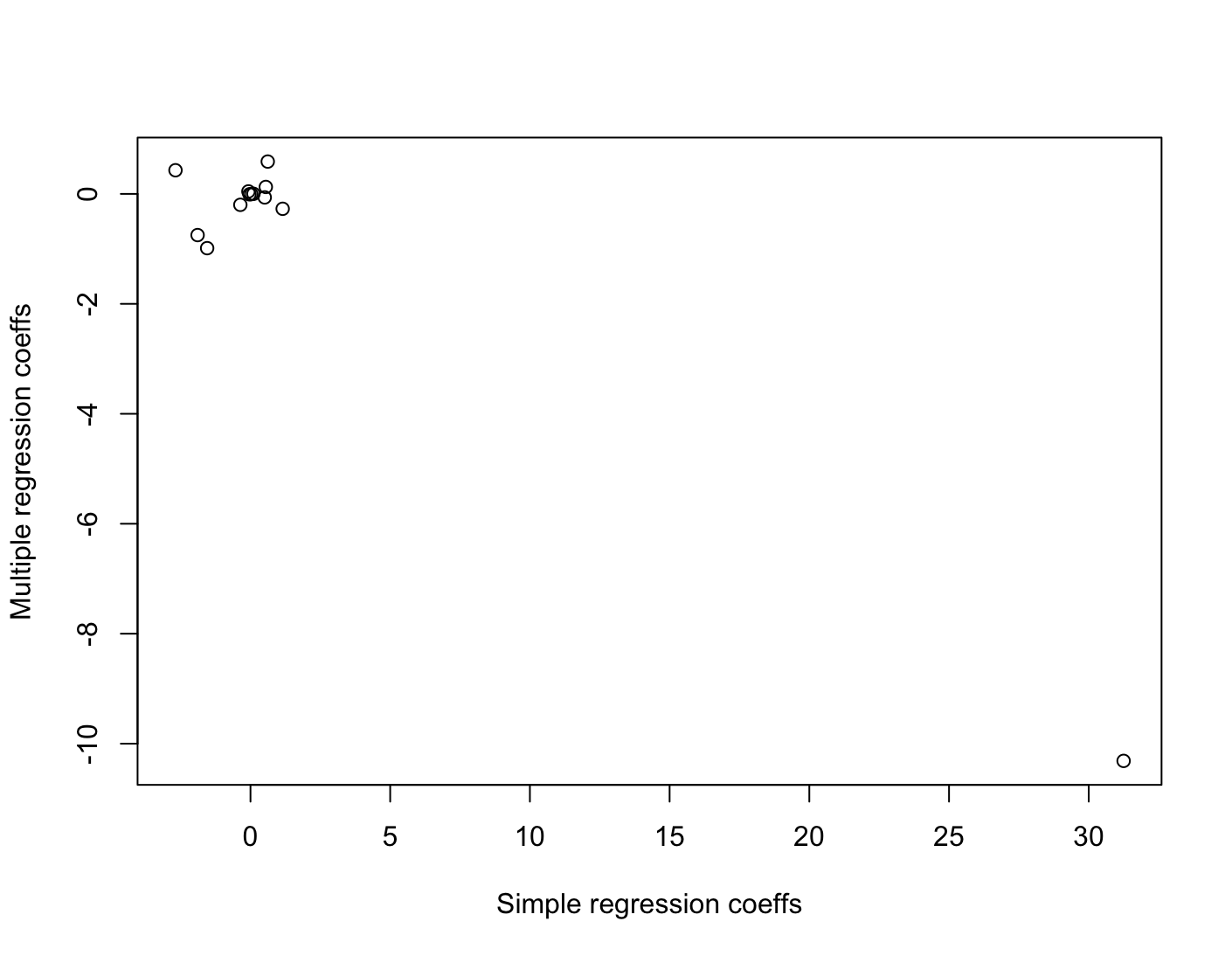
(d) Is there evidence of non-linear association between any of the predictors and the response? To answer this question, for each predictor $X$, fit a model of the form
\[Y=\beta_0+\beta_1 X+\beta_2 X^2+\beta_3 X^3+\epsilon\]columns2 = columns[-3] # usunięcie zmiennej char bo powodowała error: # Error in poly(chas, 3) : 'degree' must be less # than number of unique points x1_p_values = c() x2_p_values = c() x3_p_values = c() for (x in columns2) { lm = lm(paste("crim", "~", "poly(", x, ", 3)"), data=Boston) x1_p_values = c(x1_p_values, summary(lm)$coefficients[2,4]) x2_p_values = c(x2_p_values, summary(lm)$coefficients[3,4]) x3_p_values = c(x3_p_values, summary(lm)$coefficients[4,4]) } results = data.frame(row.names = columns2) results$x1_p_values = x1_p_values results$x2_p_values = x2_p_values results$x3_p_values = x3_p_values print(results)x1_p_values x2_p_values x3_p_values zn 4.697806e-06 4.420507e-03 2.295386e-01 indus 8.854243e-24 1.086057e-03 1.196405e-12 nox 2.457491e-26 7.736755e-05 6.961110e-16 rm 5.128048e-07 1.508545e-03 5.085751e-01 age 4.878803e-17 2.291156e-06 6.679915e-03 dis 1.253249e-21 7.869767e-14 1.088832e-08 rad 1.053211e-56 9.120558e-03 4.823138e-01 tax 6.976314e-49 3.665348e-06 2.438507e-01 ptratio 1.565484e-11 2.405468e-03 6.300514e-03 black 2.730082e-19 4.566044e-01 5.436172e-01 lstat 1.678072e-27 3.780418e-02 1.298906e-01 medv 4.930818e-27 2.928577e-35 1.046510e-12 ```R print(results[results$x3_p_vlues < 0.05, ])x1_p_vlues x2_p_vlues x3_p_vlues indus 8.854243e-24 1.086057e-03 1.196405e-12 nox 2.457491e-26 7.736755e-05 6.961110e-16 age 4.878803e-17 2.291156e-06 6.679915e-03 dis 1.253249e-21 7.869767e-14 1.088832e-08 ptratio 1.565484e-11 2.405468e-03 6.300514e-03 medv 4.930818e-27 2.928577e-35 1.046510e-12Dla niektórych modeli zmienna $X^3$ jest statystycznie istotna więc istnieje dowód na to, że dane nie są liniowo zależne.